
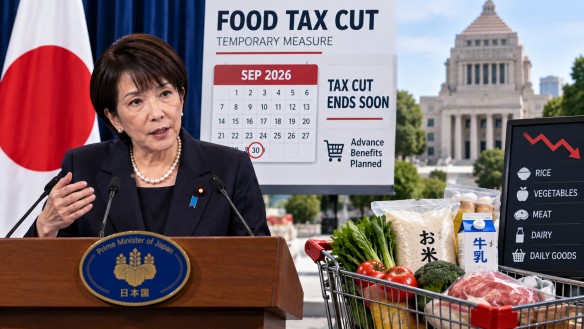
In a strategic move to alleviate the financial burden on low- and middle-income households, Japan’s government is set to introduce advance cash benefits as a temporary measure bridging the gap when the reduced consumption tax on food is due to expire in 2029. The initiative outlines a plan to lower the food tax from its current 8% to 1% for a two-year period commencing in April 2027. This reduction is designed to ease immediate financial pressures, with plans to preemptively disburse half of the annual benefits to qualified households as the tax reverts to 8% in April 2029.
The income-sensitive program is slated for launch in April 2027, offering varying payment amounts based on each household’s income level and the number of children. It is anticipated that the initiative will involve annual expenditures of approximately ¥600 billion, equivalent to $4 billion, during the fiscal years 2027 and 2028. As discussions continue to finalize the policy, the government aims to present the necessary legislation to an extraordinary parliamentary session scheduled for October.
Funding for this tax relief is projected to be sourced from an assessment of existing subsidies, special tax arrangements, and government expenditure, deliberately avoiding the issuance of deficit-financing bonds. However, the specific financial sources remain under deliberation as the government seeks to solidify its approach.
In addition to household benefits, the government plans to implement supportive measures for sectors such as agriculture, forestry, fisheries, and the restaurant industry, all of which stand to be affected by the impending tax changes. Retailers, on the other hand, will be granted additional time to adjust to requirements for tax-inclusive price displays, offering them some reprieve in adapting to the new tax framework.